Beijing, once a secondary player, now aspires to the top spot in just two decades.
Launch Centers For instance, in infrastructure, China operates six launch centers simultaneously and has secured offshore launch platforms, rapidly increasing its annual launch count. Private rocket companies have grown to over a dozen, with total commercial space investments reaching $11.4 billion (approximately 16 trillion Korean won) between 2015 and 2024. The Tiangong space station, currently operational in low Earth orbit, is expected to amplify its presence as the only state-run space station after the International Space Station (ISS) is retired.
In deep space exploration, China has achieved milestones: Chang'e-4 made the first landing on the far side of the Moon in 2019, and Chang'e-6 successfully collected soil samples from that side last year. Beijing aims for a crewed lunar landing by 2030, Mars sample return by 2031, and a lunar base by 2035.
The Space Science Forum (CSF) highlighted that through its "Space Silk Road" strategy—which integrates satellite manufacturing, launches, ground station construction, and data centers—China is strengthening ties with nations in Asia, Africa, and South America. It warned that reliance on loans and long-term maintenance could lead these countries to become dependent on Chinese digital and space standards.
The CSF positively evaluated China's pace of simultaneous progress across the Apollo, ISS, and New Space eras. It emphasized that Beijing is redefining the global space order at an astonishing speed in lunar missions, low Earth orbit, and satellite communications. "If the United States and its allies do not respond now," the CSF warned, "the space order, including the Moon and low Earth orbit, could be led by China by the early 2030s."
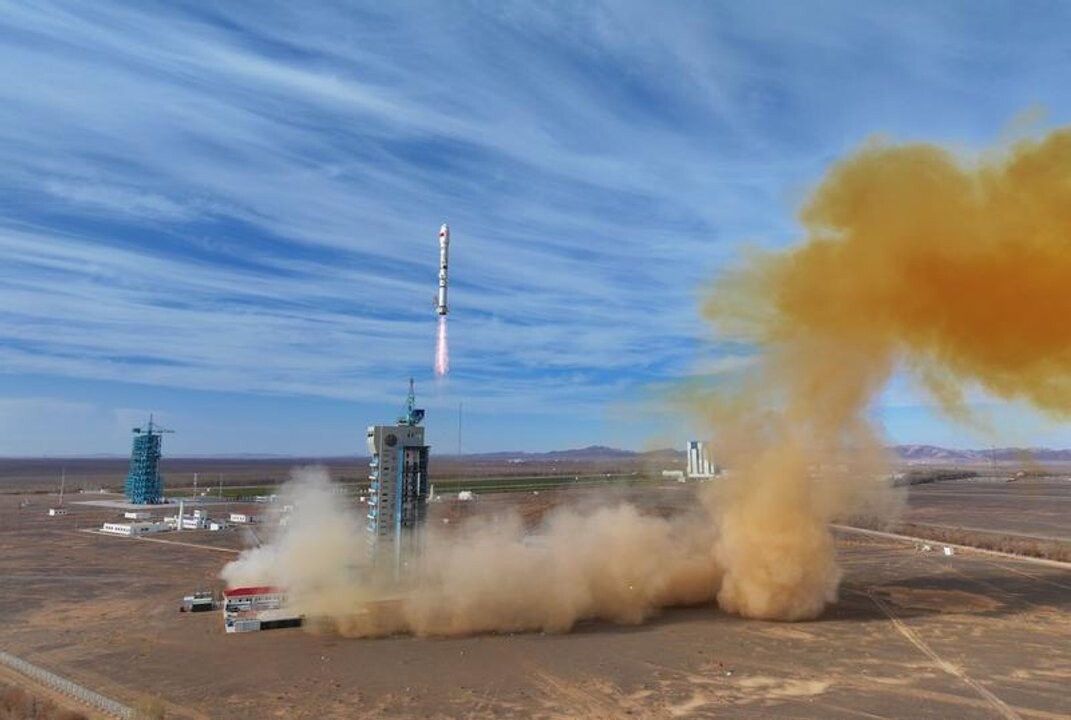
JIUQUAN, Nov. 19, 2025 (NA/Xinhua) -- A Long March-2C carrier rocket carrying three new satellites lifted off from the Jiuquan Satellite Launch Center in northwest China, another step for the Asian giant in the space race. The vehicle lifted off at 12:01 (Beijing time), placing the Shijian-30A, Shijian-30B, and Shijian-30C satellites into their preset orbits. These satellites will be mainly used for space environment exploration and related technology verification.
Wednesday's mission was the 608th flight in the Long March carrier rocket series. The satellites, launched by China in November 2025, are designed to conduct in-orbit tests and collect data on the space environment. The Shijian ("practice/experiment" in Chinese) series focuses on the development and validation of new space technologies. China's Long March rocket family has formed the backbone of its space program for decades. The Long March-2 series, including the 2C used in this mission, originates from China's earliest ballistic missiles.
Shijian satellites have carried out a variety of missions, from reusable and returnable test platforms (like Shijian-19, which returned to Earth with biological and technological test payloads) to developing cutting-edge capabilities. For example, Shijian-25 (launched earlier this year) specifically aims to test in-orbit refueling and mission extension technologies. These experiments demonstrate China's ambition to extend the lifespan of its satellites and reduce the costs of future space operations.
The New Space Era
The Commercial Spaceflight Federation (CSF), a key player in the "New Space" era where private entities lead space exploration and development, stated: "China is no longer a follower but a nation setting the pace in the space race, surpassing the United States in multiple areas."
Specifically, it noted that by the 2030s, China could dominate the Moon and low Earth orbit. Projections suggest Beijing could surpass the United States as the world's leading space power within 5 to 10 years. In its recent strategic report, Redshift, the CSF analyzed that China's rapid growth in space is based on three pillars: sustained investment in infrastructure, dominance in low Earth orbit, and achievements in deep space exploration. The title Redshift—which refers to the astronomical phenomenon where the wavelength of light stretches as galaxies move away—symbolizes how China's advances are transforming the space race.